Spread Weaver: a tarot journal where the reader stays the reader.
Spread Weaver gives tarot readers a place to lay out a spread and write an interpretation. AI reflection is optional and starts from the reader’s words. It offers questions and connections, not a verdict.
The first version is not taking new customers. The images and decisions below document the original version.
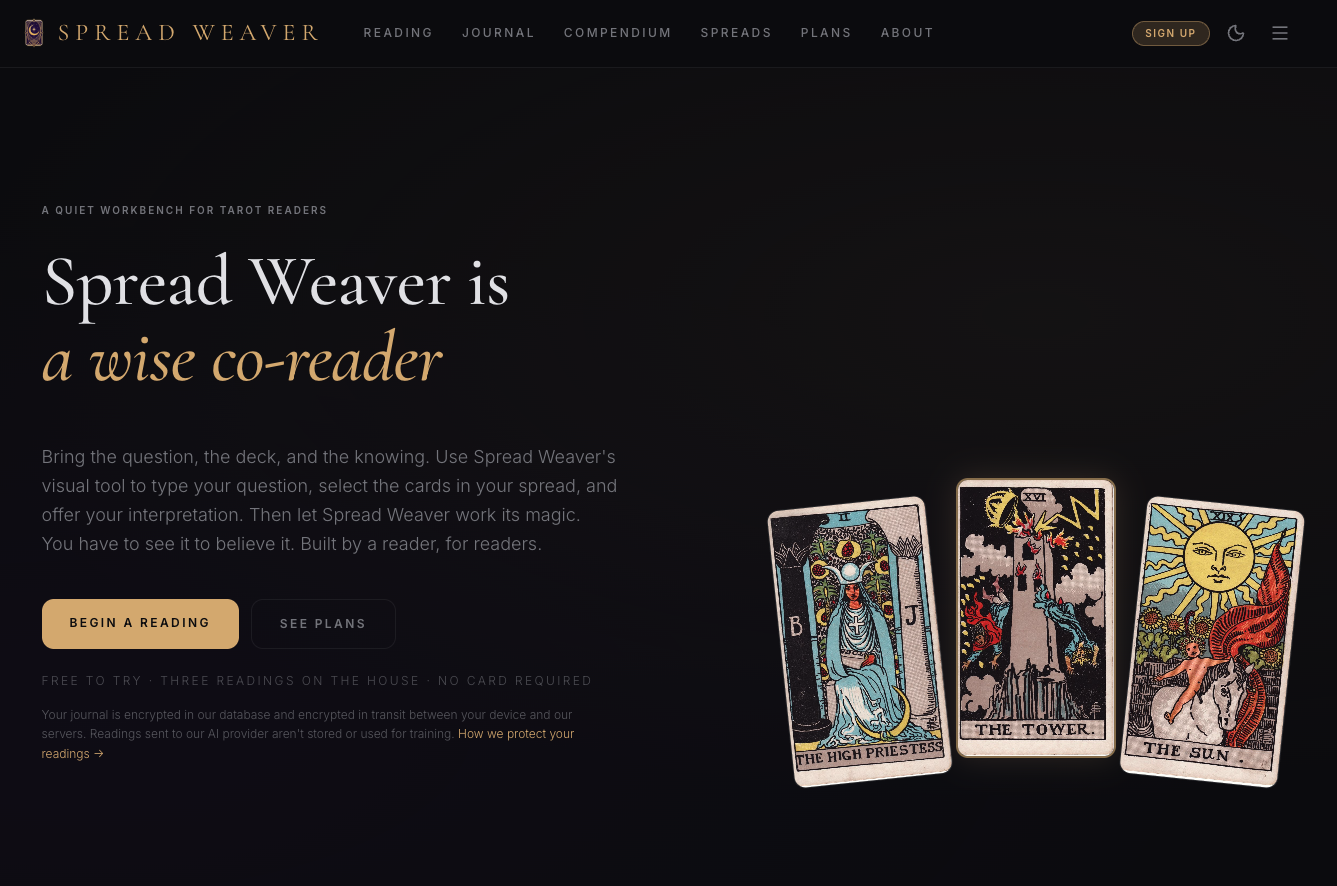
A generated reading gives a person an answer. It does not give them practice in interpreting. We wanted to support the reader’s own eye: what they notice in a card, how they relate it to a question, and what changes over time.
The practical need was a place to keep spreads, notes, and card history together. A notebook can do much of that. A digital journal can also make earlier entries easier to find and compare, while leaving the interpretation with the reader.
The order matters: the reader interprets first, then chooses whether to invite AI reflection.
Experience, intention
& interpretation
Reflection, patterns
& questions
Meaning, judgment
& next steps
Human first. AI collaborating.
Spread Weaver was designed from the same principles that guide Resonant Era. The table below shows how each principle shaped a product decision.
People set the direction
People choose when to use AI and remain responsible for the decisions they make.
The reader interprets first. AI reflects only when invited.
Begin with lived experience
We learn how a person works before deciding what a tool should do.
A spread, the reader’s own words, and a journal of their practice come first.
Make the role of AI clear
Show where AI is involved, what it is being asked to do, and where its output needs review.
AI offers questions and connections, never a prediction or verdict.
Leave room for reflection
A useful tool should leave people room to notice, understand, and think for themselves.
Earlier readings remain part of the journal, giving the reader time and context to notice patterns.
Room for the cards and the reader’s words.
A dark surface lets the colours of the cards stand out. Serif text gives journal entries room to breathe. Labels stay small, and transitions are restrained so the reading remains the focus.
Surface
A dark background keeps attention on the cards and the journal entry.
Type
Serif text for journal entries; monospaced text for labels and structure.
Layout
The spread takes the main workspace. Supporting controls sit around it.
Motion
Slow fades keep transitions from interrupting the reading.
Visual spread builder
Lay any spread, name the positions, and keep the layout with the entry.
Journal with continuity
Every reading searchable, with a card's history across your own practice.
Reflective AI companion
Optional reflection based on the reader’s entry and journal context.
Reader-led sequence
Interpretation comes before AI reflection, with a choice at each reading.
The original Spread Weaver brought the spread, the journal, and optional AI reflection into one workspace. Version 2.0 is underway, and the first website is not taking new customers.
This is the approach we bring to client work: understand the practice, keep decisions with the person, and give the technology a defined job.
What does your website need to do?
The Studio covers website strategy, design, development, and maintenance through one monthly membership.
Get in touch